Showing posts with label saints. Show all posts

Tuesday, April 21, 2009

April 23rd: St. George's Day

For St. George's Day on Thursday I'm thinking we will :

  • Read Saint George and the Dragon by Geraldine McCaughrean (or just look at the pictures if the story is way over Cherub's head)
  • Make a handprint dragon
  • Make fairy cakes and use red and white icing to make a St. George's cross
Again, there are a many ideas for activities and crafts at Activity Village.

For more about Saint George, see this post that I wrote back in 2006. And here is a prayer to St. George.

Tuesday, March 03, 2009

March 5th: St. Piran


I had relatives in Cornwall when I was a child, and fell in love with this beautiful, mysterious, Celtic county in the far south-west of England. As March 5th is the feast day of St. Piran, the patron of Cornwall, here are a few ideas for celebrating St. Piran and all things Cornish:

Who Was St. Piran?
Piran's origins are obscure, but it is known that he was born in Ireland and died around 480. He built a small oratory at Perran Beach (near Perranporth) where he first landed in Cornwall. It is likely that he was either a follower of the Irish saint, Kieran of Saighir, or maybe Kieran himself. Read about him at the Patron Saints Index or the St. Piran Trust. St. Piran's oratory was a place of pilgrimage throughout the middle ages, although a second church was built further inland when attempts to stop the first being smothered in sand were abandoned. Today the St. Piran Trust is trying to raise funds to excavate the sites of both the Oratory and the Old Church. The Oratory is believed to be one of the oldest surviving Christian buildings in Britain.

Food
Cornish pasties ... if you can't get to Cornwall or a good pasty shop to buy the real thing, you can make your own. I haven't made them for years, but I think I will try this year. My recipe is much like this one.

Cornish splits with strawberry jam and clotted cream.

Prayer
Say the Lord's Prayer in Cornish
(If you would like to hear some Cornish, listen to the BBC News in Cornish here)

Activities
Cornwall colouring page

Daffodils are associated with St. Piran's Day celebrations, so any daffodil craft such as this handprint daffodil would be appropriate.

The Cornish flag is the cross of St. Piran - a white cross on a black background. Legend has it that St. Piran lit a fire on his black hearthstone. Tin ore within the stone was smelted and rose to the top in the form of a white cross. Make or colour some Cornish flags of your own.


From black Cornish rock he built his hearth

A blaze of fire rose hot and bright
And from the fire a molten river
Pure metal was made, of splendid white.

Explore Cornwall
Cornwall in Focus has information about all aspects of Cornwall, and an extensive photo gallery.

You can find lots of pictures to use as wallpaper here

Wednesday, November 26, 2008

St. Catherine of Alexandria

In honour of my name saint ... a day late, but hopefully of use next year!

A Few Facts

Timeline: died c.305 at Alexandria, Egypt
Feast day: November 25th
Patronage includes: lacemakers, librarians, unmarried girls, educators, students and schoolchildren
Colours: St. Catherine's colours are green for wisdom and yellow for faith

The story of St. Catherine is legendary and for this reason her name was removed from the calendar of saints in 1969. It was reinstated in 2002 and she is now considered an intercessor for unity between the western and eastern Churches, where she is greatly venerated.

Things to Read

Children

  • Saints for Young Readers (Susan Wallace)
  • Lion Treasury of Saints
  • A Story of St. Catherine of Alexandria by Brother Flavius (Neumann Press)
Adults
Picture Study


Traditions associated with St. Catherine


Lacemaking was an important occupation here in Bedfordshire, and "Cattern's Day" was an important holiday for the lacemakers. Cattern's Day marked the point of the year at which lacemakers The day was celebrated with "Cattern cakes" and the custom of jumping over a lighted candlestick. This was the origin of the rhyme:
Jack be nimble, Jack be quick
Jack jump over the candlestick
The tradition of making and eating Cattern Cakes dates back to the saint's namesake Catherine of Aragon, the first wife of King Henry VIII ...
The origin of [Cattern Cakes] was the concern of Catherine of Aragon, who when hearing the plight of the lace makers of Bedfordshire, burnt all her lace and commissioned new lace, thus keeping the lace makers employed. There after the lace makers contributed to a fund that provided tea and cakes on this day.
In France, heart shaped cakes are given on St. Catherine's Day to unmarried women over the age of 25 to encourage them to find love. The women are called "Catherinettes" and wear green and yellow hats.

Food for St. Catherine's Day

Craft Ideas:


Prayers:

O God Who gavest the Law to Moses on the summit of Mount Sinai,
and didst miraculously place the body of Thy blessed virgin-martyr Catherine
in the selfsame spot by the ministry of Thy holy angels,
grant, we beseech Thee, that her merits and pleadings
may enable us to reach the mountain which is Christ.
(Collect of St.Catherine from traditional Roman Lectionary)

Almighty and eternal God,
who gavest to Thy people the invincible virgin and martyr Saint Catherine,
grant that, by means of her intercession,
we may be strengthened in faith and constancy,
and spend ourselves unsparingly
in working for the unity of Thy Church.
(New collect of St. Catherine from Roman Lectionary)

St. Catherine, St. Catherine, O lend me thine aid
And grant that I never may die an old maid.
(Traditional)

Finally ...

Check out St. Catherine on Facebook!

Wednesday, July 16, 2008

St Swithin's Day

I noticed belatedly that yesterday was St. Swithin's Day. Tradition says that if it rains on his feast day, it will rain for the next forty days:

St Swithin’s Day, if it does rain
Full forty days, it will remain
St Swithin’s Day, if it be fair
For forty days, t'will rain no more.
Yesterday was dry. Is it too much to hope that we are in for a spell of nice summer weather? Tomorrow's forecast is for rain, but I can dream!

Unfortunately, our dry day wasn't matched elsewhere, and according to the Daily Mail the prospects are not good:

'Most places had some rain, drizzle or showers,' said the Met Office's Sarah Holland. While the hard-headed meteorologists at the Met Office would usually have little time for a ninth-century saint, for once their official prediction appears to support the legend.

They are forecasting a long, wet summer. 'We expect it to be a typical British summer with rainfall and temperatures a little bit above average,' added Miss Holland. 'There are no signs of any long, hot spells yet, although the second half of July might be a little warmer and drier.'

This summer's unsettled weather is influenced by La Nina - the cooling of the Pacific. The phenomenon has moved the jet stream - the band of fast-moving air high in the atmosphere - further south than normal, bringing cooler, wet conditions.

Like many pieces of weather folklore, the St Swithin's Day proverb contains seeds of truth. By mid-July, British weather has usually settled down for the summer and rarely swings from one extreme to another.

However, despite searching through 55 years of records, researchers have shown that rainfall on St Swithin's day has never led to 40 days of rain.

So that's all right then!

And who was St. Swithin (or Swithun), the saint behind the legend? This comes from the BBC website:
Saint Swithin was a Saxon bishop. He was born in the kingdom of Wessex and educated in its capital, Winchester. He was famous for charitable gifts and building churches. His emblems are rain drops and apples.

Swithin was chaplain to Egbert, the 802-839 king of Wessex. Egbert's son Ethelwulf, whom Swithin educated, made him bishop of Winchester in 852.

Only one miracle is attributed to Swithin while he was alive. An old lady's eggs had been smashed by workmen building a church. Swithin picked the broken eggs up and, it is said, they miraculously became whole again.

Swithin died on 2 July 862. According to tradition, he had asked to be buried humbly. His grave was just outside the west door of the Old Minster, so that people would walk across it and rain fall on it in accordance with Swithin's wishes.

On 15 July 971, though, Swithin's remains were dug up and moved to a shrine in the cathedral by Bishop Ethelwold. Miraculous cures were associated with the event, and Swithin's feast day is the date of the removal of his remains, not his death day.

However, the removal was also accompanied by ferocious and violent rain storms that lasted 40 days and 40 nights and are said to indicate the saint's displeasure at being moved. This is probably the origin of the legend that if it rains on Saint Swithin's feast day, the rain will continue for 40 more days.

Saint Swithin is still seen as the patron of Winchester Cathedral.

Thursday, September 06, 2007

Thursday Thirteen #18: Favourite Saints

Excluding the Holy Family to leave more scope, a slightly random selection of favourite saints (ask me again tomorrow and I would probably give a different list) arranged in more or less chronological order ...

1. St. Peter. I find it so reassuring that Jesus chose an impetuous fisherman who couldn't live up to his own expectations to lead his Church.

2. St. Thomas. Another thoroughly human saint. If even one of the Twelve could doubt Jesus, I feel better about my own weaknesses and inadequacies.

3. St. Joseph of Arimathea. The rich man who gave up his own tomb to Jesus, only to have it become the site of the Resurrection. The story that Joseph subsequently came to England and settled at Glastonbury may be legend, but it is a beautiful one.

4. St. Helena. I can't help but admire a woman whose influence helped convert an Empire, and who trotted off to the Holy Land in her old age to try her hand at archaeology. And she is one of my patrons, as my middle name is Helen.

5. St. Nicholas. The real Santa Claus.

6. St. Benedict. The father of monasticism in western Europe. His rule is so humane and still applicable nearly 1500 years after he wrote it.

7. St. Thomas Becket. Who would have guessed that King Henry II's egotistical, display-loving chancellor would end up a saint and a martyr. Pig-headed, stubborn and at times a thorn in the flesh even of his friends, Thomas's flaws make him seem very real to me.

8. St. Hugh of Lincoln. An outstanding English medieval saint. Even Henry II was prepared to tolerate outspoken cricitism from Hugh, which says a great deal for his force of character.

9. St. Francis of Assisi. Simply extraordinary.

10. St. Thomas More. Brave, humane, intelligent, likeable, and prepared to die rather than go against his conscience.

11. St. Teresa of Avila. An woman of great energy and humour as well as outstanding spiritual qualities. I chose her as my confirmation saint, then realised later that her feast day is my birthday.

12. St. Bernadette of Lourdes. One of the first saints I "met" after I became a Catholic.

13. St. Michael the Archangel. Can I count him? Representative of all those angels that guard and defend us. (I suppose chronologically he should be first!)

Saturday, August 18, 2007

Little Cherub's Liturgical Year Book

I have been working on a project intermittently for the last month or so ... a Liturgical Year Book for Little Cherub. I bought three small 6 inch by 4 inch photo albums from Paperchase - just the right size for little hands - and I am filling them with simple pages for various feasts, seasons and saints days. Each book holds 24 pages, so there will be 72 altogether, each with pictures for her to look at and some simple text or a prayer. The plastic holders mean the books will be robust for her to handle. Here are a couple of sample pages from the August to November book I am currently working on:

Feast of Ss.Michael, Raphael and Gabriel, Archangels (September 29th):


St.Therese of Lisieux (October 1st):

Sunday, January 14, 2007

Our Patron Saints

This year I want to make more of an effort to celebrate our own patron saints and their feast days. I also decided to copy Amy of Among Women and pick patrons for the year. (OK, so I was nearly two weeks late, but better late than never!). I used the tables of contents of various saint story books to make up a list of 160 saints, chopped them up (the paper, not the saints!) and we each picked one out of a hat.

Bookworm
Name saint: St. Catherine Labouré
2007 patron: St. Elizabeth the Peacemaker

Angel
Name saint: St. Helen
2007 patron: St. John Bosco

Star
Name saint: St. Anne
2007 patron: St. Louis Marie de Montfort

Little Cherub
Name saint: St. Rose Philippine Duchesne
2007 patron: St. Francis of Assisi

We usually add a short litany at the end of morning prayers, so will include our patrons as well as name saints in that. I plan to mark their feast days and read anything we can find on each saint. Beyond that, as yet I have no ideas whatsoever!

Wednesday, January 03, 2007

Living the Liturgical Year: January (Part 1)

A bit behind the event here, but I'm posting what I have in my folder so far for the first three days of January. It may come in useful next year!

January 1st - Mary, Mother of God (Solemnity)
(Not a Holy Day of Obligation here, though I think it is in the US?)

I had never seen this picture - Kissing the Face of God, by Morgan Weistling - until Rebecca of A Gypsy Caravan put it into this post. I think it is beautiful. Rebecca is kindly sending me a copy and I plan to make it the centrepiece of a display for both this feast (next year!) and other Marian occasions. Aren't blogging friends nice :).

I collected some prayers together and made our own simple family prayer books for the Advent and Christmas seasons (only one sheet of folded printer paper for each). This is the prayer I included for this feast. I can't remember where I found it. Possibly Catholic Culture?

Father, source of light in every age,
the virgin conceived and bore Your Son
Who is called Wonderful God,
Prince of Peace.
May her prayer,
the gift of a mother's love,
be Your people's joy through all ages.
May her response,
born of a humble heart,
draw Your Spirit to rest on Your people.
Grant this through Christ our Lord.
Amen.

January 2nd: St.Basil
Katherine at A Living Education posted about St.Basil and Vasilopita (St.Basil's bread) here, and also gives a recipe for Vasilopita. I am a Grecophile, so I like the idea of adding an edible tradition with a Greek flavour to our New Year.

January 3rd: The Holy Name of Jesus
As the month of January is dedicated to the Holy Name I plan to have the girls focus on this later in the month. A few activity ideas:
  • make IHS monograms
  • make posters decorated with the different names of Jesus (I noted down Lord, Saviour, Emmanuel, King of Kings, Lamb of God, Prince of Peace, Son of God)
  • read the story of St.Bernardine in Saints for Young Readers for Every Day (May 20th), or 57 Stories of Saints by Anne Heffernan
  • copywork - first verse of hymn 'At the name of Jesus'
  • catechism - focus on the second commandment "You shall not take the name of the Lord your God in vain" (CCC 2142-2167)
Today we said the Litany of the Holy Name as our morning prayer. (Angel and Star are less fond of litanies than I am. At the end they said rather plaintively, "we don't have to say that every day, do we?")

As the year goes on I hope to build up a collection of items to display with our liturgical candle. This year it will be very much a work in progress, but hopefully next year we will be pretty much set after this year's efforts. As well as the picture of Our Lady I want to add an icon of St.Basil and the monograms and Holy Name posters to my stash.

Wednesday, December 27, 2006

Saint Thomas of Canterbury


One saint I almost feel I know personally is Saint Thomas of Canterbury. At university I was tutored by the editor of his letters, and her enthusiasm for Thomas rubbed off. I took a course she taught on King Henry II, in which she spent almost as much time discussing Thomas as she did the king and his reign. My good luck!

Feast Day: December 29th

A Few Facts
Born 1118 in London, died 1170 at Canterbury
Ordained as archbishop of Canterbury 1162
Patron of clergy
Saint Thomas is often known as Thomas Becket, though he himself never used the surname, or as Thomas a Becket, which is a much later variation. His correct title is Thomas of Canterbury.

Reading
If All the Swords of England by Barbara Willard (published by Bethlehem Books)
Murder in the Cathedral by T.S.Eliot (play)

Online: Thomas Becket the Chancellor and Thomas Becket the Archbishop from Stories from English History by Alfred J.Church
Eyewitness account of the martyrdom of St Thomas
And my own version of the story of St Thomas: Murder at Canterbury

A Virtual Tour
Find Cheapside, the street where St. Thomas was born, on a map of the City of London. The City of London is the old city, now the financial district and only a small part of modern city. The ancient medieval streets still exist, but they are now lined with office blocks.

Any surviving remnants of the City St. Thomas would have known were destroyed by the Great Fire of 1666, which also destroyed the medieval St. Paul's Cathedral. You will have to make do with a visit to the "new" St. Paul's designed by Sir Christopher Wren.

Visit Canterbury Cathedral, the site of St. Thomas's martyrdom.

Activities for the Feast of St. Thomas
from Catholic Culture

Other Resources
Teaching activity from the British Library using original sources to investigated the story of St Thomas.
Links to articles and activities from Schoolhistory.co.uk
(Both of these are aimed at 11-12 year olds)

Prayer
O God, for the sake of whose Church the glorious Bishop Thomas fell by the sword of ungodly men: grant, we beseech Thee, that all who implore his aid, may obtain the good fruit of his petition. Through our Lord Jesus Christ, Who livest and reignest with Thee in the unity of the Holy Spirit, forever and ever. Amen.

Wednesday, December 13, 2006

Our St. Nicholas icons

We finally finished them. Star found some bronze coloured card which worked well as a background. We have been displaying hers in between the two Advent calendars, though it has now disappeared behind our nativity set (not enough space to display everything!)

We'll be putting them away at Christmas and keeping them for next year. I'm hoping that if we do crafts like this for different saints and feast days we can build up a selection of simple items and pictures to display through the year alongside our liturgically coloured candle holders.

Wednesday, December 06, 2006

Book Review: The Real Santa Claus

Title: The Real Santa Claus
Author: Marianna Meyer
Age Suitability: Age 7 or 8 up

As today was the feast of St.Nicholas we read The Real Santa Claus by Marianna Meyer. Unfortunately it was one of those books that I expected to be a success but the girls took a dislike to. Despite some grumbling I ploughed on to the end, but it was a damp squib. I loved the wonderful art used to illustrate the book, and I also thought it was a good retelling of the known facts about St.Nicholas and the various legends attached to him. Angel and Star decided it was boring and that was that. Why? Because the style is a little heavy. The author does tend to use a long word where a shorter might be better. I think this is more than outweighed by the positives, but the girls thought otherwise.

Oh well. Can't win 'em all!

Tuesday, November 14, 2006

I love this

... marvellous slide show of November Feasts by Katherine at A Living Education.

I think Angel and I could have fun with this. I wonder if slide shows can be posted on Blogger?

Thursday, November 02, 2006

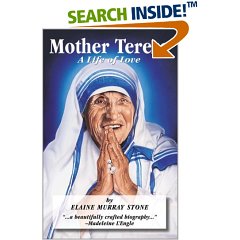
Book Review: Mother Teresa

Title: Mother Teresa: a Life of Love
Author: Elaine Murray Stone
Age Suitability: 10+ (but see caveat)

Angel and I ploughed through this book, but it never took off. It was a bit too dull and worthy, and never made Mother Teresa come alive to us. A shame when you consider what a wonderful, vibrant woman she was and what an extraordinary life she led. At the end Angel claimed to remember nothing about Mother Teresa at all ... if she feels she has been forcefed anything even vaguely historical she has a talent for wiping it from her mind (though I like to think that something sticks, somewhere). I just asked her for an opinion of the book ... "boring and hard to understand". It didn't catch my interest either.

If you want your child to read this book, be aware that there are a couple of sections which talk about abortion and artificial birth control. They could be omitted or edited when reading aloud.

Sunday, September 03, 2006

Saint Cuthbert


Tomorrow (September 4th) is the feast of one of the great saints of northern England, St. Cuthbert. Why not take a little time out of your day to meet this Anglo-Saxon saint?


Some Facts

Born 634
664 Prior of Melrose Abbey (Benedictine)
685 Bishop of Lindisfarne
Died 687
Patronage: sailors, shepherds, England

Reading
Saint Cuthbert from Our Island Saints by Amy Steedman
Catholic Encyclopedia entry
Saints O'the Day: March 20th (in the English liturgical calendar Cuthbert's feast is celebrated on September 4th, the date his incorrupt body was moved to Durham Cathedral when Lindisfarne was attacked by Vikings).
Bede's Life and Miracles of St Cuthbert

How do we know about Cuthbert?
Most of what we know comes from the biography written by Saint Bede the Venerable. Bede also lived in Northumbria (the northernmost kingdom of Anglo-Saxon England), just fifty years after Cuthbert himself.

Virtual Tour
Visit the shrine of St Cuthbert at Durham Cathedral and the Holy Island of Lindisfarne. Walk St Cuthbert's Way from Melrose to Lindisfarne (if you have the energy for 62½ miles!).

Nature Study
Find out about St Cuthbert's Beads.


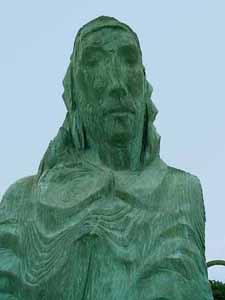
Bronze statue of Cuthbert of Farne on Lindisfarne.

Friday, August 11, 2006

Little Flower of Lebanon

I have been desperately saddened watching the news of recent events in Lebanon and Israel, and Love2Learn's post about St.Charbel of Lebanon struck a chord. It also reminded me about another Lebanese saint whose intercession we could ask for peace in the Middle East - St.Rafqa (or Rebecca), the Little Flower of Lebanon. I would like to mention two particular intentions, one general and one personal:

(1) For the Lebanese and Palestinian Christian communities, caught up in troubles not of their own making.

(2) For Tevye's Israeli cousin Micki and her family. She is in London for the summer but her home is in Haifa, one of the areas suffering missile attacks, and her sons and grandchildren are all in Israel.

St.Charbal and St.Rafqa, pray for us!