Thursday, April 05, 2012

Book 12: K is for Knitting

Knitting Around the World: A Multistranded History of a Time-Honored TraditionKnitting Around the World: A Multistranded History of a Time-Honored Tradition by Lela Nargi

My rating: 2 of 5 stars

I bought this book with a gift voucher because it looked beautiful. The illustrations of different styles of knitting, both modern and historical, are stunning. But the text! Never has a book been so sorely in need of a good editor. From about 30 pages in I admired the pictures and skimmed the rest.


For more reviews visit 52 Books in 52 Weeks

Wednesday, April 04, 2012

This England: Evenin' All


A combination of spring and the upcoming Diamond Jubilee made me think it would be nice to do a series of England themed posts about things, people or aspects of life here that make me happy and that I think of as particularly English.

First up ... we have a police force in which it is the exception not the norm for officers to carry firearms (this of course also applies to Wales and Scotland, not just England). While there are designated armed response units and certain specialist forces carry arms - police with machine guns at airports are now routine, for example - most policemen and women do not. Todays police force isn't in the Dixon of Dock Green era any more, but it is one of very, very few in the world that is not routinely armed. The only others I found in a quick search were Iceland, New Zealand and Norway.


Dixon of Dock Green, the lead character in a gentle British TV series which ran from 1955 to 1976. Dixon  fought petty crime in the East End of London armed only with his trusty truncheon! Each programme began with the catchphrase "evenin' all" - which police in certain forces are no longer supposed to say, as apparently the word "evening" is subjective. Huh?

A few English police facts:

  • The first English police force was set up in London in 1829 by Robert Peel. The nickname "bobbies" for policemen came from his name.
  • Police cars were traditionally black and white, so became known as "panda" cars.
  • Some police patrol on bicycles. The Metropolitan (London) Police force has 1500 police bikes.
  • The last policeman killed in the line of duty was PC Gary Toms of the Metropolitan Police in April 2009. 
  • In 2010 there were 143,743 full time equivalent officers serving in 43 police forces in England and Wales.

Free clipart flag from Aspex Designs

Tuesday, April 03, 2012

Book 11: Jilted Generation

Jilted Generation: How Britain Has Bankrupted Its YouthJilted Generation: How Britain Has Bankrupted Its Youth by Ed Howker

My rating: 2 of 5 stars

I felt like a break from my A to Z reading challenge and picked up (can you "pick up" a book on a Kindle?) this book which I bought recently as a Kindle Daily Deal. It looks at the ways in which those aged under 30 in Britain get a raw deal compared to their parents' generation. It is divided into chapters on housing, jobs, inheritance and politics. Some of the points made are interesting and thought provoking, but there were sections where I felt the authors were either misinterpreting the evidence or being over selective in their use of facts to support their points. Overall it left me with as many questions as answers.

For more reviews visit 52 Books in 52 Weeks

Saturday, March 31, 2012

Book 10: J is for Jobs

Steve JobsSteve Jobs by Walter Isaacson

My rating: 4 of 5 stars

I am an Apple geek - Windows makes me shudder! - and have been wanting to read this biography of Steve Jobs since it was published at the end of last year. I was intrigued to find out what made Jobs tick and just how he managed to come up with products that have, quite literally, changed the world - graphical user interfaces for computers (remember the DOS prompts that they replaced?), digital music players, smartphones and tablet computers. Apple was the first company to popularise all of those products because in each case it produced something simple, beautiful and user friendly.

So how did Jobs do it? By being a flawed genius. He knew when something was right, he knew good design, and his aim was always to make the best possible product rather than to maximize profits. He was a visionary who refused to do market research because he didn't care what customers thought they wanted - his aim was to make the things they didn't yet know that they would want. The flaws? He was a control freak, temperamental, self-centred and often utterly horrendous to deal with - yet that control freakery and his determination that the laws of the possible didn't apply to him or to Apple (people who knew him called it his reality distortion field) meant that time and again he was able to achieve the seemingly impossible. It may also ultimately have killed him, or at least shortened his life, because his refusal to accept that it was necessary led him to put off surgery on his pancreatic cancer for several months.

The book was written at Jobs' instigation and with his approval, though he knew that it would not always be flattering. It is well written, and so far as I can tell well researched and balanced. I found the insight into Jobs' personality and the history of the various Apple products fascinating. Goodreads marker for 5 stars is "absolutely amazing", so maybe not quite a 5 star but if I could I'd give it a 4 and a half.

Thursday, March 29, 2012

All Change!

Another week that whizzed by at 100 miles per hour!

The good news ... after my interview on Thursday I was offered a part-time job as an archivist. This means that from the middle of April I will have TWO jobs in the same place - I will still be doing 2.5 days a week cataloguing and will also be working as an archivist for another 2 days a week. That adds up to pretty much full time, which is a bit scary! In September the hours will change to 2 days a week cataloguing and 3 days a week as an archivist, so will be truly full time. Fortunately that is only going to be a temporary thing. When my existing contract expires in July 2013 I will be left with the three days a week archivist's job, which is exactly what I was hoping for when I started out on this road. So, the next year or so is going to be pretty hectic.

Working full time isn't ideal but it is manageable, though I'm glad it is only going to be temporary. Fortunately Tevye works at home two days a week and will be able to get home early enough on one other day to collect Rose from school. I will be able to collect her on Fridays, and she will go to after school club for about three-quarters of an hour on Mondays until Helen can pick her up on her way home from school. Between my holidays from work (I get 26 days annual leave), Tevye's work at home days and some baby sitting help from Helen and Marie we can cover school holidays without it getting too stressful.

Oh, and I'm still going to be studying for my archive qualification. Eek! I'm looking forward to starting the job and getting the chance to put theory into practice though.

Sunday, March 18, 2012

Muthers Day

Today is Mother's Day in the UK, or "Muthers Day" as Rose spells it. (If you are Catholic, note the liturgical connection - Mother's Day falls on Laetare Sunday, a day of celebration in the middle of Lent.) She presented me with a poem she wrote on the computer at school - all her own idea, done independently - which I just have to share:

My Mum

My mum kind
She is polite
Her voice is sweet

My mum is pretty
She is lovely

My mum is clever
She is always cuddling me
Her hair is byootfall

My mum is cute
She is lovable
Her vois is pretty and soft

Almost entirely inaccurate - for starters my hair is not byootfall, neither is my voice pretty and soft! - but super, super cute.

Saturday, March 17, 2012

7 Quick Takes: 16th March 2012

It has been a while since I did one of these ...


1. Yesterday was Helen's 17th birthday. In the UK that is the magic age for DRIVING! She has her provisional licence ready to go and will be heading off for her first driving lesson after school today. Before she is allowed to drive solo she has to pass a theory test and a rigorous practical test. She has saved the money to pay for her lessons and we have said we will insure our small car for her to drive. Fortunately it is in a low insurance group - car insurance for teenagers is horrendously expensive.

2. Changes are happening at work and I have an internal job interview next Thursday. If all goes well things will be good but busy!

3. This week's most bizarre parenting moment ... Marie phoned just after she had left for school to say she had just remembered she urgently needed a pair of chopsticks painting black for that evening. Apparently she had promised her ballet teacher she would take them to use as wands (no, I don't know why!). And yes, I was very kind and found and painted a pair for her.

4. Odd question this morning from Rose ... is it earwigs or woodlice that bite? As far as I am aware neither of them do, but she is convinced she has been bitten by one or the other. We came to the conclusion that if she really had been bitten by one of them then it must be an earwig. So, I'll pass the question on ... do earwigs bite???

5. I am now driving instead of catching the train to work. Since I have been working longer hours it was getting more and more of a juggling act to fit in my hours around train times - there is only one train an hour which meant I was losing a lot of the benefit of flexible working hours. The drive takes me about 40 minutes, which isn't too bad.

6. J-next-door (age 17) is now an apprentice hairdresser and is here doing a job lot of hair cuts - Mum, Rose and myself. She has wanted to be a hairdresser since she was two (really!) and worked in hair salons as a Saturday girl for two and a half years before starting her apprenticeship last summer. She is very good!

7. Small siblings of teenage sisters tend to be precociously aware of social media. Marie told Rose that she would take a photo of her in her new glasses. "Yes," said Rose, full of enthusiasm, "and then you can put it on Facebook!"

Visit Conversion Diary for more quick takes

Tuesday, March 13, 2012

The Poor Laws

I have had to do quite a bit of research on the Poor Laws lately, first for my archive course and then to give a talk at work, and have found it fascinating. Before this, the little I knew about provision for the poor was that unemployment benefit (in certain circumstances) and old age pensions were introduced in the early 20th century and expanded into more generous payments with the introduction of the Welfare State in the 1940s. I kind of assumed that before that there were workhouses for the most destitute but otherwise the poor were pretty much left to sink or swim. I was wrong. In fact, England has had a formal system of provision for the poor for over 400 years. While it is fresh in my mind, I thought I would jot down the outline of the history of the Poor Laws. If you like history, carry on reading. If not, feel free to skip!

The original English Poor Law (different laws applied in Scotland) was introduced in 1597 and replaced in 1601 with a Poor Law that lasted for over 200 years. Under this "Old" Poor Law parishes were responsible for providing for the poor and needy within their bounds. Each parish appointed overseers of the poor to dispense relief as necessary, and all property holders within the parish had to pay a compulsory Poor Rate to finance it. Most parishes had some sort of poorhouse or workhouse where paupers unable to support themselves (mainly the old, the sick and children) could live - the standard of these varied widely, and could be pretty grim - but most support for the poor was given as cash payments, either to replace earnings for those unable to work or to supplement inadequate earnings. This interesting article about research based on records in the archive where I work estimates that in the late 18th century the elderly could receive pensions from the poor rate amounting to as much as 70% of the typical labourer's income.

By the late 18th and early 19th century the cost of providing for the poor was rising under the pressure of economic changes, bad harvests and the Napoleonic wars, and economic theorists began to argue that providing poor relief undermined the labour market and people's willingness and ability to provide for themselves (the concept of "scroungers" is not a new one!). By 1834 these ideas had become mainstream and triggered the introduction of a New Poor Law, which was intended to deter all but the most destitute from claiming relief. The New Poor Law tried to standardise provision for the poor through a central Poor Law Board that issued instructions to local Poor Law Unions which combined all the parishes in a local area. Each Union was expected to build a workhouse to accommodate all paupers within its boundaries. Workhouses were supposed to be as unappealing as possible, with a bland diet, no luxuries whatsoever, uniform clothing, hard and demeaning work (breaking stones and picking apart old ropes were common tasks), and the separation of families. Cash payments to paupers were supposed to end and those unable to support themselves were supposed to have no option but to enter the workhouse. In practice, this was never the way it worked. Workhouses were generally unpleasant places, though rarely as bad as Charles Dickens painted them (think Oliver Twist!), but payments continued to be made to many paupers living in their own homes. Local Boards of Guardians, who ran the Poor Law Unions, tended to resent central interference and to ignore or only partially implement instructions from the Poor Law Board. Putting a family into the workhouse was far more expensive than simply giving them help to stay in their own home, and in times of high unemployment forcing all paupers into the workhouse would have been impossible. In the end most workhouse inmates were those unable to work - the old, the sick, the incapable and children. The workhouse carried a terrible stigma and for the elderly the idea that they may have to end their days in the workhouse was a matter of dread.

The Poor Law came to an end in 1930 and was replaced first by provision for the poor through County and Borough Councils and after World War II by a centralised Welfare State. Most of the workhouses continued to be used for related purposes, either as hospitals for the poor or old people's homes, and many were eventually taken over by the National Health Service - in fact, I wonder whether the NHS would have been feasible in its existing form without the network of infrastructure it inherited from the Poor Law Unions.

Monday, March 12, 2012

Checking In

Updates on the various medical matters ... the hospital discharged Mum on Tuesday, only six days after her op which is a record for her, and she is staying with us until we decide she is well enough to go home. Not surprisingly given the spectacular bruising her leg is still very painful, but she is gradually getting more mobile. We took her out for a walk to the end of the drive yesterday, the first time she has been outside since the op. It is still very slow as she is having to learn how to use her joints all over again - her walking was so poor before that even the leg that wasn't operated on is struggling to remember what to do! I was a little concerned about the incision on Saturday and took advantage of the out-of-hours District Nurse service. A lovely nurse came out, checked the wound over (all fine!) and dressed it. The first time Mum had a hip replacement a nurse came out on New Year's Day to put a new dressing on. Great service!

My chest is better. Not quite 100% yet, but the cough has almost gone and I didn't end up with a chest infection. Phew! Rose went back for her follow up appointment with the optician. This time her eyes behaved better and although she does need glasses for reading, school work, using the computer and watching TV, the prescription isn't as strong as the optician thought it might be and he expects her to outgrow the need for glasses in time. She has picked out "dark pink" (her description) metallic frames with a little picture of Snow White on the side. Very five year old girl.  The orthodontist is happy with the way Marie's teeth are progressing, and says that even with the current braces the wires should soon get more stable as the gaps where she had teeth extracted close up. I hope so!

Helen had a parent-tutor evening at school last week. Her tutor is very happy with her - she works hard, is making good progress, and is predicted decent grades. Quite a number of kids in her year had taken their first AS level exams in January and got their grades back. Apparently a lot of people were very unhappy with their maths results - there is a big jump in difficulty between the GCSEs they took last year and AS level and it showed - which has put her off the idea of picking up maths again next year and she is now thinking she will just continue with the three subjects she is doing this year (English Language, Media Studies and Photography) and add in ICT as an extra.

Oops! Just realised I should have woken the girls up quarter of an hour ago! Have a horrible feeling this morning is going to degenerate into a frantic rush.

Saturday, March 10, 2012

Book 9: I is for Immortal

Immortal Life of Henrietta Lacks The Immortal Life of Henrietta Lacks by Rebecca Skloot

My rating: 4 of 5 stars

It was coincidental that I read this after The Help, but it made a good follow on as it also tells the story of a black woman in mid-20th century America. This time it was non-fiction rather than fiction, and about both life and death. Henrietta Lacks, a young mother of five, died from a virulent cervical cancer in the 1950s but a cell culture taken from her tumour became the first to be kept alive successfully in the laboratory. The extraordinary vigour of HeLa cells has made them central to scientific and medical research ever since. This book hits the sweet spot between human interest and science, merging the stories of Henrietta herself, the family who outlived her, and the cells she left behind. It also opens up an ethical can of worms - while HeLa cells became a multi-million (or billion?) pound business, her family did not learn about them until 20 years after her death and when they did discover that Henrietta's cells were alive they were left to flounder in a mix of incomprehension and resentment. Even today the legal position regarding the use of medical tissue samples is murky. My verdict? A fascinating story, thoroughly researched and well told.

Thursday, March 08, 2012

Book 8: H is for Help

The HelpThe Help by Kathryn Stockett

My rating: 4 of 5 stars

This book tells the story of life in a Mississippi town in the early 1960s in the voice of one white woman and two black maids and does it very well, managing to communicate some of the subtleties that existed under the extreme racist veneer of that time and place and bringing in a wide and varied cast of characters. It is a book I am glad I read and one I would definitely recommend. Having said that, I didn't find it an easy book.

Many years ago Tevye visited relatives in South Africa. He remembers it as the most beautiful place he has ever been, but also remembers the profound discomfort he felt on seeing the "Whites Only" signs and the guilt he felt at using "Whites Only" facilities. This book left me feeling a bit of the same discomfort as it brought home to me just what the entrenched divide between black and white in mid-20th century Mississippi really meant - I already knew a fair amount intellectually, but this helped me to understand it on a more personal and emotional level. As a result I both enjoyed the book but was simultaneously disturbed by the insight into attitudes and a way of life that dehumanised so many people.

I'm slipping behind a bit on my 52 books in 52 weeks which has now reached week 10, though as I was a bit slow to review  The Help I am already nearly at the end of Book 9, so not doing too badly!

Sunday, March 04, 2012

Medical Matters

We seem to be going through one of those spells where every week has "personal maintenance" appointments of some type for someone. Between the five of us and my mother there seems to be a constant stream of visits to the doctor, the dentist, the optician, the orthodontist, the chiropodist and so on. Last week it was the optician for Rose and the asthma nurse for me, not to mention that my mother had her hip replacement surgery. Next week it is the orthodontist for Marie and the optician again for Rose.

Rose has surprised me. When we took my mother to the optician's a couple of weeks ago she complained that her eyes were blurry. She sailed through her pre-school eye check and is reading well, so I assumed it was either because she had a bit of a cold or just association of ideas because we were at the optician's, but I made an appointment for an eye exam just to be on the safe side. It turns out she was right, and her eyes really are blurry. She is long sighted with a slight astigmatism and is going to need glasses. She has to go back again next week to have eye drops to relax her eyes so that the optician can measure the prescription properly (apparently little people's eyes work so hard adjusting focus it is hard to get an accurate measurement without something to calm them down). We now understand why she has been reluctant to move up reading levels at school. She has tended to look at books from the next level and say they are too hard, though the lower level books are way too easy. Her teacher and I both put it down to lack of confidence and coaxed her along. It turns out Rose was right. The books are hard - not because the words are too difficult, but because she struggles to see the smaller print! It also explains why she doesn't often volunteer answers in phonics lessons - it isn't that she is too timid, she just can't see the board properly!  From what I have been able to dig out of her, it seems she didn't have any problem in her first year at school, last term it was getting a little blurry, and this term it has got worse.

After 18 months of not having any asthma problems and feeling I had it well under control, I got overconfident. In December I got a chest infection, and now a slight cold has turned into an evil cough. Throwing everything I had at it (stronger preventive inhaler and maximum dose of reliever) was just about holding things together but wasn't really making any headway, so now I'm on the first course of steroids I've had in two or three years. Two days in and I'm still coughing and puffing, so I'm keeping my fingers crossed it will work and doesn't turn into another chest infection.

Marie and braces is turning out to be a complete pain as the wires keep breaking. In the six weeks she has had them we have been back to the orthodontist twice with broken wires. She has now broken two more, but fortunately has a routine appointment booked for Tuesday so can wait until then. I presume the breaks are because the wires have to stretch unsupported across the gaps where she had molars removed to make space for the rest of her teeth. Apparently she will get a stronger type of brace after six months, but I can see us trekking backwards and forwards to the orthodontist ridiculously often until then.

All of which makes me incredibly thankful yet again for the National Health Service. Out of all that lot, all I have had to pay is £14.80 for two prescriptions. Rose's glasses will be free, as is Marie's orthodontic treatment (though I seriously hope they don't cap the number of times they will deal with broken wires!). I was able to book my medical appointment online with my choice of doctor or nurse (I picked an asthma specialist nurse). It saddens me to see that the US election year is beginning to trigger outbursts against "socialized medicine" in general and the British NHS in particular, which according to the Republican candidate Rick Santorum has "devastated" the UK. Huh? I picked up on this from William Oddie's response at his Catholic Herald blog, from which I also discovered this staggering statistic:

The US spends 7.4 per cent of GDP on healthcare (to which very few are entitled). We spend 7.2 per cent of GDP on the NHS for a system to which everyone in the population has an absolute right, and which most of those (I am one) who actually have any real experience of it, consider pretty effective
I think that alone is enough to indicate that our system is not a disaster. I wrote a bit about the different perceptions of healthcare in the US and UK in the aftermath of the last US presidential election here. For what it's worth, I don't think our system would be possible in the US and the changes Obama is trying to introduce are not even remotely similar to the NHS, which was a product of particular historical circumstances - not just the aftermath of the Second World War as I mentioned in my previous post,  but also a long history of social provision though the Poor Law in this country, dating back over 400 years. I don't know what the answer is for America, but I do know that holding the NHS up as a devastating and disastrous example of what could happen there as a result healthcare reform is just ridiculous. I know there are many Americans who would love to have our health service. I don't know anyone here who would wish to replace the NHS with a system based on private health insurance.

Saturday, March 03, 2012

Neglectful Blogger!

Oops! Nearly two weeks since I last posted! Tevye and I spent last weekend at our all time favourite hotel, leaving girls scattered in various places. At almost 17 Helen now stays home alone, forcing her to confront the reality of dishes that do not wash themselves. Rose stayed with K and A-Next-Door, where part of the routine when she stays is to go for a pub lunch, which always includes chips (fries) for her.

Me: What are you most looking forward to about staying next door?
Rose: Pub!

All went well. We had a good break. Rose enjoyed her chips, and getting taken bowling by the next doors teens, and generally being made a fuss of. Marie spent the weekend with a girl who has been a close friend since she was nine, and as she calls C's family her "second family" she was happy. Helen didn't burn the house down.

Here are a few pictures (taken with my phone, so not the greatest):

The bridge house at Ambleside. As you can see the weather was decidedly Lake District grey. At least it didn't rain on us.


I love the Lake District stone walls. Isn't this house wall at Ambleside neat!


A view from Coniston


On the way home was stopped off here


In this town


And ate this (or at least I did. Tevye ate a steak sandwich)


Then strolled around the gardens, both indoors


And outside


And here is a gratuitous picture of Tevye and myself, which I very rarely take, let alone post!

Monday, February 20, 2012

Knitting Update

It is an age since I posted any knitting pictures, so here is an update on recent projects.


I finally finished the aran cardigan that I started the Christmas before last (apart from buttons). The pictures aren't great but they give an idea of the end result. 


This was an awful lot of cabling but the end result was worth it. A cosy, classic cardigan, which will be warm enough to wear instead of a coat in spring and autumn. 


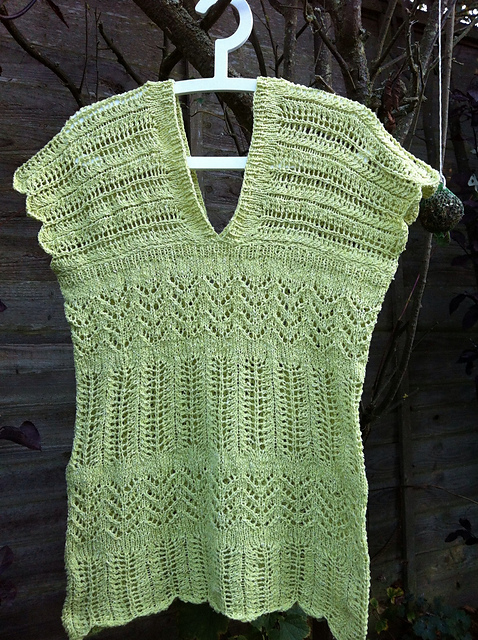
Another successful project for myself was this green lace vest using Wendy Bernard's Jordan pattern. I haven't worn it yet as I finished it in October, but I think it will get quite a bit of use in the summer. The yarn was discounted end-of-line Jaeger Trinity. This is a very simple lace project knitted as a tube and two flat rectangles.


There have been smaller project too. These are my third pair of skew socks (for me!):


And I knitted this Bella's mittens pattern for Helen for Christmas in Rowan Cocoon. Gorgeously soft and warm. I shamelessly borrow them!


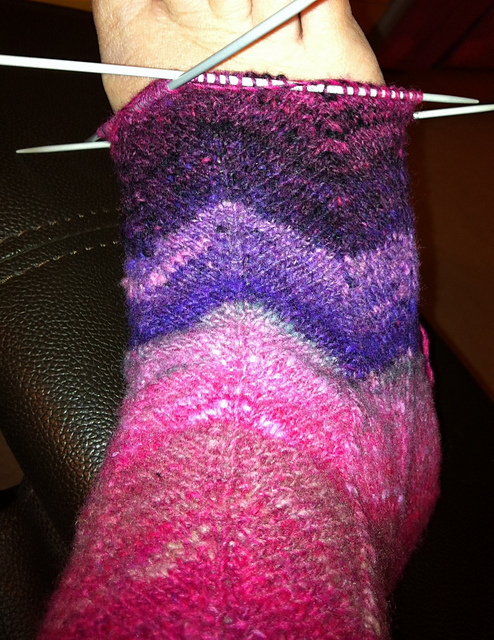
My current projects are a grapevine sweater in the same yarn as the Jordan vest and a pair of Jaywalker socks in Noro Kureyon sock yarn. I like this wavy pattern and it works beautifully with the colours of the yarn. I am being very brave and just knitting the socks as they come rather than trying to match the colour sequence on each socks. The anal part of my brain really feels that non-identical socks is a radical move! This is the first time I have used Noro. Having read lots of comments about its shortcomings - scratchy and uneven texture being the usual criticisms - I was very unsure whether I would like it, but I picked up a couple of balls in our local yarn shop's January sale. Although the thickness variations are crazy (in places it is more like one ply than four ply and in others there are thick clumps of badly spun yarn) I actually like it better than I expected. The colours really are lovely and I am very happy with the way it is coming out. 

I have another ball of Noro Kureyon that I am thinking of turning into an Ishbel shawl. I am also seriously considering making this beautiful St. Ninian's Scarf in one ply Shetland yarn. It looks challenging but well worth the effort.

Friday, February 17, 2012

Book 7: G is for Ghosts

Ghosts of SpainGhosts of Spain by Giles Tremlett

My rating: 4 of 5 stars

This one just squeaked up to four stars. Written by a British author who lives and is raising his family in Madrid, it looks at modern Spanish culture and how it has been shaped by history. Although I have studied bits of Spanish history, I have only visited Spain once and didn't have much of a sense for how Spain and its people tick. Much of the book was fascinating and I now feel I know a lot more about the country, including certain aspects that were a complete blank to me before - flamenco, Basque separatism, and the establishment of democracy after the death of Franco, to give a few examples. There was also a section on contemporary morality which was pretty graphic! The style is quite easy to read though I did find the book a bit over long - the final chapters on different regions were still interesting, but my focus was slipping by this stage. I found the author's casually anti-Catholic attitude a bit irritating and the close association of the Church with the Franco regime uncomfortable. I also couldn't help wondering how much things have changed in Spain in the light of the financial crises fo the last few years.

Next on my list for 52 Books in 52 Weeks is The Help. I didn't see the movie so I am coming to it with no preconceptions.

Tuesday, February 14, 2012

Diamond Queen

I meant to post last week to comment on the 60th anniversary of the Queen succeeding to the throne. It was a royal-ish sort of week. Rose's school had a Diamond Jubilee themed day on Wednesday - they decided to go with the date of her accession rather than the official celebrations in June which coincide with the school's summer half term break - and the BBC started a three part documentary called the Diamond Queen. Two things in particular struck me watching the programmes that have been shown so far:

(1) Duty. If there is one word that sums up the Queen it is duty. Thanks to the sense of duty inherited from her father - who became king as a consequence of his brother Edward VIII putting personal interest first - she has spent sixty years, day in and day out, doing a grindingly hard, relentless job in which she is constantly on display. Just imagine. And she doesn't do it because she chose to live such a public life, but because it was thrust upon her. If Edward VIII had remained King and had children of his own, she would have spent her life as a comparatively minor royal.

(2) The incredible knowledge of the world and public affairs the Queen has amassed over those sixty years. Every time she meets a visiting leader or dignitary or travels abroad she is briefed and given the opportunity of conversation with them. Every week she meets the British prime minister to discuss current affairs. She takes all this seriously. Imagine the depth of personal knowledge and experience of someone who has known such an extraordinary list of world leaders: Winston Churchill, Eisenhower, John F Kennedy, Margaret Thatcher, Nelson Mandela, Charles de Gaulle, Pope Benedict XVI, to name just a few. It seems to me that this continuity is one of the benefits of monarchy - rather than a head of state changing every few years and having to get up to speed from a standing start, the Queen is able to consolidate and increase her already extensive experience year on year. Her political neutrality means that every prime minister and his government is able to draw on this, as are the heads of state of the Commonwealth countries.

Personally, I'm very much a monarchist. Here in the UK we have an old and in some ways odd political system, with no written constitution. While in matters of day-to-day government the Queen is essentially a figurehead, she is also the guarantor of the system. If, to take an extreme scenario, the prime minister decided to suspend future elections and turn himself into a dictator (though I can't say I see David Cameron as a dictatorial type!), the Queen could force an election, at least in theory - in the most extreme case it would depend on whether she could carry the army with her, which is quite likely as their allegiance is to Queen and Country rather than to the government of the day. I once had an interesting conversation about this in the House of Lords tearoom, but that is a whole 'nother story! The bottom line is that without the Queen (and her future successors) this country would not only be poorer in many ways, it would also be less stable.

God save the Queen!

(I also picked up the tie-in book for the TV series as a Kindle deal of the day yesterday, which is now waiting for me to get to Q for Queen on my A to Z reading challenge.)

Sunday, February 12, 2012

School Report

Rose ... is as good as gold at school, bless her. (Actually she is pretty good at home too!) She is very proud of the fact that she has never, ever misbehaved at school or been told off for anything by her teacher. She likes learning, and her teacher describes her as "a little sponge". Everything just soaks in. Reading is coming along fast, though she tends to need a bit of coaxing when she is ready to move up a reading level as her confidence lags behind her ability. On the whole, though, she is getting steadily more confident. She was actually excited instead of nervous about getting to collect a merit certificate in front of the whole school (at her school the kids get stamps on a merit card for good work, and after 25 stamps they get presented with a certificate). On the other hand, when the school had a professional theatre company in to perform a pantomime, Rose took one look and bolted straight back to the classroom! Fortunately her teacher had more sense than to send her back and she apparently had fun helping to do "jobs" while everyone else watched the show.

Marie ... her new school still seems to be a good fit for her and most of her teachers were complimentary, though a bit more focus and a bit less day-dreaming would be good.  She is now at the stage of choosing GCSE courses. Compulsory subjects are English Language, English Literature, Maths and Science, for which Marie has been put in an advanced group where they take three separate GCSEs in Physics, Chemistry and Biology; she then gets to do four more subjects of her choice. Her options form had to be in by the end of last week and her final choices were Art, French, History and Business Studies. Art she has always enjoyed. Her choice of history surprised me as she has always complained she doesn't like it. Apparently "history is much more interesting at this school". Glad to hear it! Business Studies is her makeweight, as there was nothing else that particularly wanted to do. French has become a favourite since she started at this school in September. I can't say enough positive things about her French teacher, who has somehow managed to enthuse Marie into working hard and using what is turning out to be a latent talent for languages. The UK National Curriculum is graded in Levels, with the average rate of progress being one full Level every two years. At the end of last school year Marie was graded as Level 4b for French (below average for her age). Suddenly she has shot up to Level 6a/7 (well above average) - in theory that is 5 years worth of progress in 6 months! At the parent-teacher consultation I said how impressed I was with how well she was doing given that she had only been at Level 4 last year. Bemused teacher said that simply wasn't possible! Amazing what a bit of effort on Marie's part can achieve.

Helen ... is also still loving the new school but had a disaster with her Product Design course when she lost a folder containing an entire term's coursework. Faced with the near impossibility of catching this up we have come up with a Plan B. She dropped Product Design - a shame in a way as she was good at it, but she did admit that the amount of work was beginning to overwhelm her even before she lost the folder - and is planning to add in Maths and ICT (information technology) next year. Usually young people in the UK who take A level course take three subjects at A2 (advanced) level and one at AS (advanced subsidiary) level. Helen will end up with two A2s (English Language and Media Studies), two ASs (Photography and Maths) and a BTEC (technical / vocational qualification) in ICT. If she decides she wants to go to university she may need to take a second year of Maths to boost that up to an A2, which she could do during a gap year, but currently she thinks she would rather look for an apprenticeship in something media or ICT related, possibly web design.

Wednesday, February 08, 2012

Too Much Stuff, Too Little Time!

Life here is busy! On that edge between very busy and crazy busy. My mum is waiting to have her second hip replaced, which will probably happen either the end of this month or early next. Meanwhile she has been needing more help than usual. She had a stairlift fitted in her house on Monday which should make life quite a bit easier for her. Getting upstairs had become a mountain to climb. We weren't sure how easy it would be to fit a stairlift as her stairs are narrow with an inconvenient bend at the bottom. After consultation with the nice man from the stairlift company I (yes, me! Apparently I missed my vocation as a stairlift engineer!) came up with a neat solution that worked - so I am feeling quite pleased with myself now it is successfully installed.

The last couple of weeks have been a marathon of school appointments for Marie and Rose (still can't get used to this name change!). There was an information evening about how Rose's school teaches numeracy, a GCSE options evening for Marie, and parent-teacher consultations for both. I'll write about those later. In amongst that, Marie has been having trouble with the wires on her braces, requiring two extra visits to the orthodontist. Helen is in a state of wild excitement as she heads off on a five day school trip to New York today.

Meanwhile I have been busy with work and study. I am still working an extra day a week, which for complicated but good reasons may increase in the spring rather than decrease as I expected. Fortunately my current archive course module is palaeography (reading old handwriting), an area where have already have a fair amount of experience. As a result the course is not too time consuming. Just as well!

Sunday, February 05, 2012

Book 6: F is for Five

Anna of the Five TownsAnna of the Five Towns by Arnold Bennett

My rating: 5 of 5 stars

The suggested theme for 52 Books in 52 Weeks for this week is Dickens. I am almost there as Arnold Bennett is an author who has been compared to Dickens. I remember reading and enjoying Clayhanger maybe 30 years ago but haven't read anything by Arnold Bennett since until I picked up this free eBook. I had forgotten just how good a writer Bennett was. Like Dickens he was a journalist who also wrote fiction. Like Dickens his work has a very strong and acutely observed sense of place - Victorian London for Dickens, the early 20th century Potteries for Bennett (the Potteries is an area in Staffordshire which was traditionally the centre of - duh! -English pottery making). Bennett's fictional Five Towns based on "Bursley" are in reality Six Towns centred on Burslem.  Like Dickens, Bennett is a master of language. What in a lesser author could be dense and turgid text in Bennett's hands becomes finely crafted description. In some ways very little happens in Anna of the Five Towns, a coming of age story in which the heroine Anna begins to break away from her miserly father and experiences the first stirrings of romance, but I found I couldn't put it down. My one disappointment was in the ending. It seemed to stop very suddenly without any of the subtlety that is characteristic of the rest of the book. Maybe it was because this is one of Bennett's early works.

As a flavour of his style, here is the first sentence:

The yard was all silent and empty under the burning afternoon heat, which had made its asphalt springy like turf, when suddenly the children threw themselves out of the great doors at either end of the Sunday-School - boys from the right, girls from the left - in two howling, impetuous streams, that widened, eddied, intermingled and formed backwaters until the whole quadrangle was full of clamour and movement."
I have a sense that Arnold Bennett's works have fallen out of fashion among the classics. It's a shame as they deserve to be more widely read.

Snow!

After a bitterly cold week we finally got our first (and only?) real snow of the winter, with three inches or so falling overnight. Rose and Marie built a snow-girl. As Rose pointed out, "you should know it is a snow-girl because it has plaits".